

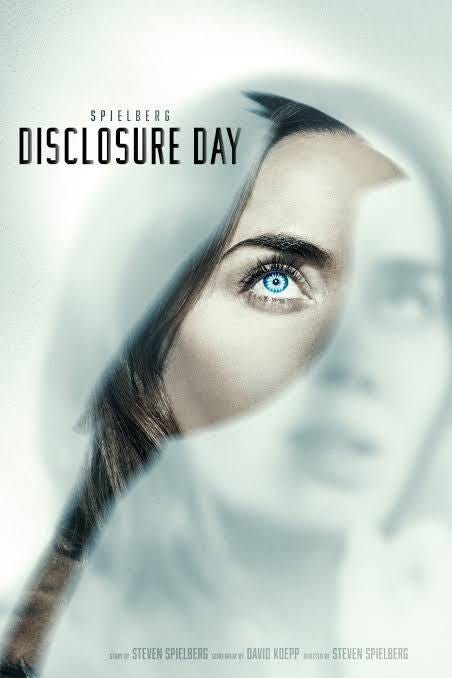
I don’t even know where to begin. All I can think about is how lucky we are to be living in a time when Steven Spielberg is still making movies.
His technical merits have been proven time and time again, so it’s no surprise that we get a film packed with camera swings that always land in the perfect spot, one-shot takes that will make you question how they are even possible, and incredible set pieces that are somehow overflowing with both heart and tension. This film is jam-packed with big, lofty ideas, but never too many at a time. Despite starting from a small-town, low-stakes conflict, the film ramps up and up until we are seeing something that affects the entire world, and beyond, as Spielberg perfectly scaffolds this film. All three acts are mesmerizing, leading into a truly breathtaking third act that does things I don’t think we’ve ever seen before.
I found myself overwhelmed with emotion as Spielberg masterfully orchestrates the magic of cinema before our very eyes. I am going to spoil the film beyond this point, because I don’t know how else to talk about it, but go see it. It’s Emily Blunt’s best performance, maybe ever? In one of the most audacious big-budget films you’ll see all year, if not this decade. Go and submit yourself to the wonder and magic of the movie hall.
Spoilers Inbound
As you might guess, Disclosure Day is not really about aliens. I mean, it is, but they are the vehicle that gets us to our destination, not the destination itself. I can see how folks may be frustrated by the marketing, or expect something different from what they actually get over this brisk two-and-a-half-hour runtime. But to that I say: grow up. Art is not made specifically for you. It’s made to be experienced. So stop shorting yourself by getting upset that a film is not exactly what you thought it would be and engage with what this brilliant director has worked so hard to bring to the silver screen.
And boy, is it brilliant. If The Fabelmans was largely autobiographical, about how Spielberg became Spielberg, then this serves as a perfect companion piece. He became what he is, as he needed to, and now he’s reckoning with the world around him. How he contributed to it. What the path looks like moving forward. Wondering if there even is one. It’s both shockingly nihilistic and overwhelmingly hopeful, two ideas so in contrast with one another that I can barely comprehend how he pulls it off. This film is just as personal as The Fabelmans, if not more so. Colman Domingo’s character, Hugo Wakefield, prognosticates that “People are starved for the truth. This 79-year terror campaign of lies has to end. Full disclosure to the whole world. That truth will upend all established order across the entire world.” I don’t think it’s an accident that Spielberg himself is 79 years old.
The opening scene is unexpected, as we see a wrestling match take place before our eyes, and before the eyes of one of our protagonists, played by Josh O’Connor. This, I think, sets up the conflict of the film: disclosure, truth. Everyone knows wrestling is fake, but we are perfectly happy to accept it for what it is and be entertained. We just want to see people fight. We don’t care how made up the reasons are. And this is really a microcosm of the world Spielberg paints in the film, one not so dissimilar from our own.
Through background images and news clips, we see that the world appears to be on the brink of World War III. Nobody quite knows what to do beyond what they usually do: uphold the status quo and look to be entertained. The news is not interested in being a truth-teller. It is interested in entertaining an increasingly vicious audience. We’ve all become so siloed, so fragmented, and Spielberg appears to feel some ownership over that. He’s not just an innocent passenger, but part of the problem, too. And this is where the film gets so interesting.
There is no obvious director stand-in, as one might expect. This is Spielberg wrestling with his inner demons. He has Emily Blunt in a career-defining role as a hilarious weather reporter for a local news channel in Kansas City. Blunt is tasked with acting through every emotion in the book, and she pulls it off with ease. You’ll find yourself laughing at her trying to break her phone on purpose, only to then find yourself unable to catch your breath as she is unable to catch hers in one of the most realistic and heart-wrenching renditions of a panic attack I have ever seen on screen.
Her superpower of empathy is on full display, manifesting in what should be cheesy but is so earnest it works, as she reads into people’s souls and appears as family. This superpower is as magical as when E.T. levitates the kids through the sky. It’s just a more grown-up and more mundane version of that, though no less special. It’s Blunt’s performance that anchors the entire film, and the narrative hinges completely on her. And she pulls it off.
Josh O’Connor is her foil, similarly dealing with the consequences of non-human intervention, though manifesting in a completely different way. His mathematical ability is off the charts, but it’s made him alone and isolated, unable to relate to others. If Emily Blunt represents our otherworldly ability to empathize, then O’Connor represents that universal and deep loneliness so many of us have struggled with. For fans of The Fabelmans, it shouldn’t be too surprising that these intertwined protagonists seem to exhibit many similarities to the doomed Spielberg-adjacent parents played by Paul Dano and Michelle Williams, emphasizing the personal nature of both films.
These two protagonists are working with our shepherd, Hugo Wakefield, played by Colman Domingo, who is in conflict with his former boss and current big bad, Noah Scanlon, played by Colin Firth. Hugo has a plan for full disclosure, and O’Connor and Blunt are, for much of the film, unknowing instruments in that plan. But Firth’s Noah is the man in black, putting the pieces together and doing everything he can to stop this from happening.
And the film does an incredible job of not overexplaining everything to you. We see this with Firth in particular. He may appear to be a caricature of a villain with nebulous motivations, but look closer and you see exactly who he is: a man who, after losing the love of his life, lost faith in humanity. A deeply tragic villain, he feels like the personification of what we often feel. Sometimes we just want to throw our hands in the air and give up. People are capable of truly horrible things. And sometimes that equation tips over to one side, and it gets easier and easier to justify your actions because of the harm that others cause. Spielberg’s genius is in knowing what to make explicit and what to leave implicit, and this balance highlights the way Spielberg can simply run circles around many of his peers.
It’s wholly compelling in a way that is rare to see on screen. And depth is the name of the game for Disclosure Day. Every character has layers upon layers. Every scene is meant to be chewed on and savored. It also happens to be very fun. From incredible set pieces like O’Connor’s breakout at the farm to an all-timer train sequence that feels Spielbergian in the best of ways, the film is always looking to ramp up the tension. As O’Connor and Blunt are smashed into an oncoming train, it’s not enough to just have another train hurtling at them from the parallel tracks; one of our mysterious NGO villains is taking aim and shooting at them, too. This is just one example of the tension so delicately woven throughout the film, which culminates in an all-timer of a third act.
And what an act it is. I resist calling the film political. I don’t think it’s political in the modern sense, but I do think it is political in that it is responsive to our world, has a point of view, and is expressly interested in sharing that. As the film culminates at a local news station in Kansas City, I found myself moved by this brilliant turn. In a world where truth is increasingly rare, news is more about spin than informing, and national news stations are being utterly dismantled through tech acquisitions and politically hostile takeovers, I was profoundly moved that the film is bold enough to add another key protagonist: local news itself.
As the film crescendos, I found myself leaning forward and breathless, fully engaged with the fantasy presented before us. For a film called Disclosure Day, that buildup to full disclosure is perfectly earned. As we see our characters succeed, not on their own but with so many others working toward a common cause, I found Spielberg tapping into something we are so starved of: community, shared moments. Watching this film just before the Knicks’ legendary NBA Championship win could not have been more perfect. For anyone in NYC that day, the final moments of Disclosure Day felt like millions of us taking to the streets as the Knicks ended a 53-year terror campaign against them. The whole city was together, in community, and that is exactly what we capture as our heroes upload the raw, unedited footage of non-human life, as the staff rally other networks to broadcast it, and as they quite astutely shut down any idea of an “exclusive.”
And so much of this hinges on the introduction of a new actress in the final minutes of the film: Courtney Grace. Grace plays a national news anchor who is live on television, receiving the same images in real time as everyone else, while also having the responsibility of doing her job and commenting on the images shown to us all. Her ratio of screen time to impact is incomparable. The entire climax of the film hinges on her performance, and it is perfect. I cannot imagine another supporting performance exceeding what Grace is doing here, and it’s incredibly brave to introduce this actress with minutes until the end of the film, at the most critical moment.
And that is the highest of compliments considering the other supporting performances in the film are also outstanding. I specifically want to highlight Eve Hewson as Jane, O’Connor’s girlfriend, and Elizabeth Marvel as Sister Maura. One of the grand ideas the film is unafraid to tackle is the impact that full disclosure may have on religion and faith. This is explored with Jane and Sister Maura, who have a relationship because Jane explored becoming a nun but ultimately did not. Despite leaving the monastery, it’s clear that Jane has not lost her faith, but perhaps just her trust in organized religion. Jane’s struggle with faith is physically manifested as she is, basically, demonically possessed as a way to get to O’Connor. It’s not subtle, but what’s the point of subtlety when tackling such big, lofty ideas?
There is a moment where Jane calls Sister Maura, getting to the heart of the questions about what she has learned and squaring it with her own struggles with faith, and Sister Maura delivers the answer beautifully. In any other film, this may have felt like too much, but in Disclosure Day, it works because it is earned. After seeing Jane wrestle with her faith over the runtime, the answer Maura gives feels deservedly profound.
That’s what Spielberg really understands. In a world where CinemaSins has effectively ruined so much of film criticism, what that shallow criticism will never be able to appreciate is the suspension of disbelief in service of a larger purpose. Spielberg perfectly ramps up the tension and conflict, puts the characters through real struggles, and manages to provide nuanced answers that feel earned.
Which gets us to the end of the film. The final moments. If I was leaning forward during the third act, my jaw was practically on the floor by the end. Full disclosure has been achieved. Hugo wheels in a real non-human life-form, finally connecting with our two protagonists, who were sent on this journey long before the events of the film take place. The alien, a word never uttered in the film, by the way, passes along a message to Margaret through our translator, Daniel. She turns to the camera, and to us, and begins to share the message with one word: “Listen.” And the film cuts to black.
As I said before, the aliens are the vehicle, not the destination, and this ending reinforces the ethos of the film. We need to listen to one another. We need to break through our silos and reject the spin. We need to empathize with one another. And this moved me so deeply because it’s true. When you are in a city of nine million people, collectively experiencing the Knicks’ incredible victory, there is something indescribably human about it. But it’s not an easy answer either. I did not find this film overly optimistic. Some days I believe we are capable of empathizing, of collective action, of making the world better, and other days I am not. We all felt it in NYC on Saturday night, but the world did not fundamentally change.
Spielberg is not arrogant enough to posit the solution here. He is just highlighting the key component that he does know: the power of empathy. The need to see one another and be seen. If we have any hope of breaking through these silos, of surviving and thriving, of helping one another, we need to relearn this superpower that makes us so unique among all of God’s creatures.