

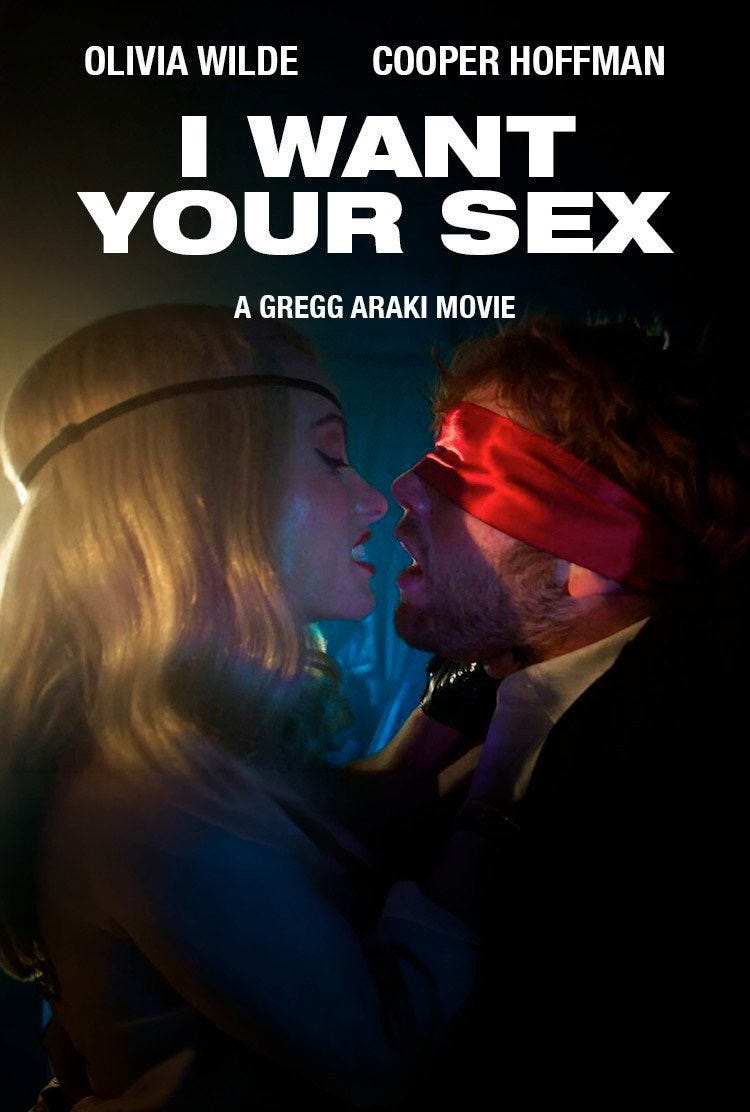
Despite some of my trepidation, I Want Your Sex is easily Araki’s best work since Mysterious Skin and his best original work since the Teen Apocalypse Trilogy. Araki is a nihilistic and funny filmmaker—and we certainly see all of that here. From Olivia Wilde’s eccentric turn as the girlboss, art queen, sexual predator Erika Tracy (an obvious stand-in for Araki himself) to Cooper Hoffman’s Gen Z beta-cuck sub Elliot, Araki uses his innate sexual sensibilities to interrogate power, generational divides, art versus artist, incels, and almost every other salient sociopolitical topic grabbing headlines today.
Araki captures just how absurd our world has become and somehow manages to both rip it apart and provide an empathetic lens through which to understand it. This is, in many ways, his most optimistic film, and I found myself thinking of both The Odyssey and Disclosure Day from earlier this summer.
All three films find filmmakers ultimately reckoning with the world they are a part of, what it is today, and the role they—or their generation—have played in getting us to where we are. Araki is doing the same here—but with a truly fresh and exciting viewpoint.
Every moment of this film feels like a master at work. I’m not sure what the budget was, but you can tell the film punches well above its weight. This is where the Araki impact is really felt—he knows how to use the environment to perfectly enhance the performances. A great bit is the frequent reveal of the bottom half of Erika Tracy’s outfits, which frankly appear downright tame compared to the words coming out of her mouth.
Hoffman’s Elliot, too, is a Gen Z-ified protagonist: working in the glamorous world of contemporary art while struggling to pay rent, dressed like a traditional blue-collar worker (in a not-so-subtle dig at the workwear trends we have seen take over the hipster-adjacent world), and drifting through life as a pseudo-incel.
Araki’s perspective and life allow him to interrogate and expose both his peers and the generation coming up now in ways that feel like a magic trick. We see artists who sometimes do manage to be the voice of a generation… or at least a voice of a generation (looking at you, Lena Dunham), but I so rarely see a filmmaker manage to delicately balance different generations and the distinct experiences informing their lives, then bring them together in an ultimately hopeful message.
Yes, it feels like generational conflict is as old as time. The older generation will always complain about the younger generation and vice versa. You had it so easy. I had to walk uphill in the snow both ways to school. You could buy a house and afford school by working summer jobs. You could just drop off your résumé at a company and get a job. It’s an endless list of grievances—and yet we all inhabit the same world at the same time. We are all flawed and still have to work together.
And yeah—we might cause some damage along the way. But maybe if we worried a little less about being righteous and being a victim, we might actually be able to learn from one another, grow, and move through this fucked-up world a little bit better.
For a film about contemporary art and sex, I found it to be a prescient thesis on these seemingly insurmountable walls we are so ready to erect between those we see as different or wrong. The politics of the film may feel either anti-woke or post-woke—it doesn’t really matter. In fact, the film seems wholly disinterested in adjudicating facts or truth. There is a false catharsis in being “right.” We seek truth and facts as the ultimate goal when that’s an impossible folly—one that neither makes us feel better (at least beyond temporarily) nor helps us actually live with one another successfully.
Yes, Erika Tracy is a monster. And Elliot is an aimless and passive “victim” navigating a harsh world. Neither of those truths matters, though. Tracy and Elliot both need to break down their own walls and learn from one another. This isn’t pretty (though it is certainly entertaining), but it is necessary.
Life’s hard. Bad shit happens. You’re dealt the hand you’re dealt—so do whatever you can with it instead of grasping so desperately just to maintain some façade of stability. I Want Your Sex expertly tackles all of this in 90 minutes, leaving my face actually hurting from smiling so much.