

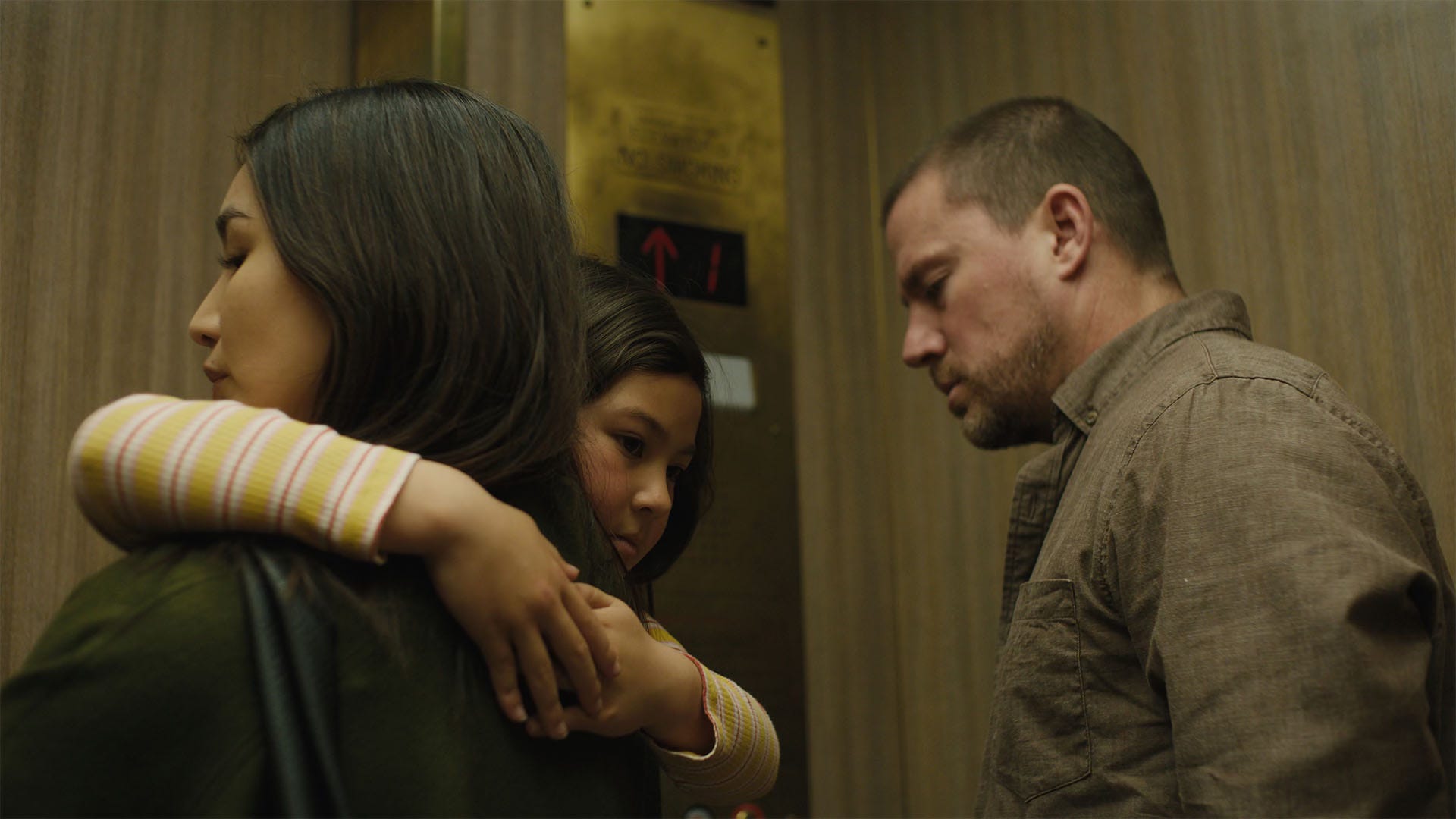
Josephine begins with a young 8-year-old girl (our titular lead, played miraculously by Mason Reeves) jogging in the park with her father, Damien (Channing Tatum in another spectacular dramatic role), when she witnesses a brutal rape.
This scene is harrowing, and not since Gaspar Noé’s Irreversible have I seen such a gratuitous crime take place on screen. I’ll admit I found this immediately off-putting, but the perspective with which we see this crime, specifically from Josephine’s point of view, is, in my opinion, necessary for the film that Beth de Araujo has succeeded in making.
This is a film about female fear—something we all generally know about and half the population sadly experiences. The fear of walking alone at night. Entering a bathroom alone. The fear of a man losing his temper and getting violent. The film has plenty to say about that too—male violence—but it’s this specific and confident lens that de Araujo channels through Claire (Josephine’s mother, Gemma Chan) and Josephine herself that takes center stage.
An 8-year-old girl witnesses something that nobody should ever see, let alone experience, and her whole world is blown wide open. You see, in those devastating first moments, her innocence crumble, never to be seen again. As adults, a crime like this is incomprehensible. As a child, I don’t think there is even a word for it. Josephine does not have any context, any language, or any perspective—but the world does not wait for us to grow up; it forces us to, often in tragic ways.
This tragedy is seen over and over again with Channing Tatum and Gemma Chan playing her parents. Damien is fit, strong, and knows how to fight back. He is, by almost every definition, a “good” man. But he’s hard. He’s been hurt physically and has not dealt with the fact that much of his pain is now rooted in his mind. Claire is a great foil to Damien. She’s softer, more graceful. Where her husband is a fan of contact sports and self-defense, she is a professional ballerina and willing to admit the realities of the world that her husband thinks you can defend from. She knows that’s not possible. Sometimes terrible things happen. Sometimes there is nothing you can do to stop it. And those terrible things? They don’t exist in a silo—they affect us every day, in big and small ways.
Which brings us to Josephine. Frankly, I am astonished they were even able to make this film, and I have to trust the filmmakers took all precautions to protect her from the trauma this film seeks to explore. Mason Reeves, in her first role ever (the director found her at a farmer’s market), is the true standout here. She perfectly captures a child trying to understand but being just unable to do so—the fear that didn’t exist one day and suddenly is all-consuming the next. She’s observant and quiet, but it’s her unrelenting strength, slowly building through the two-hour runtime, that will leave your jaw on the floor, culminating in an excruciating courthouse scene where a diabolical defense attorney will have you pulling your hair out in chunks.
By the time the film reaches its final stretch, Josephine has tightened its grip completely. De Araujo understands that fear isn’t a single event; it’s a lifelong rearranging of the self, of a family, of what “safe” even means. The film is formally controlled, emotionally devastating, and cathartic in the way it refuses easy closure. It’s the kind of movie you walk out of shaken, then realize you can’t stop thinking about—because it didn’t just show you something horrific; it showed you what it does to a person. Expect to see this film in the Oscar conversation come year-end.