

La Gradiva
4.5/5
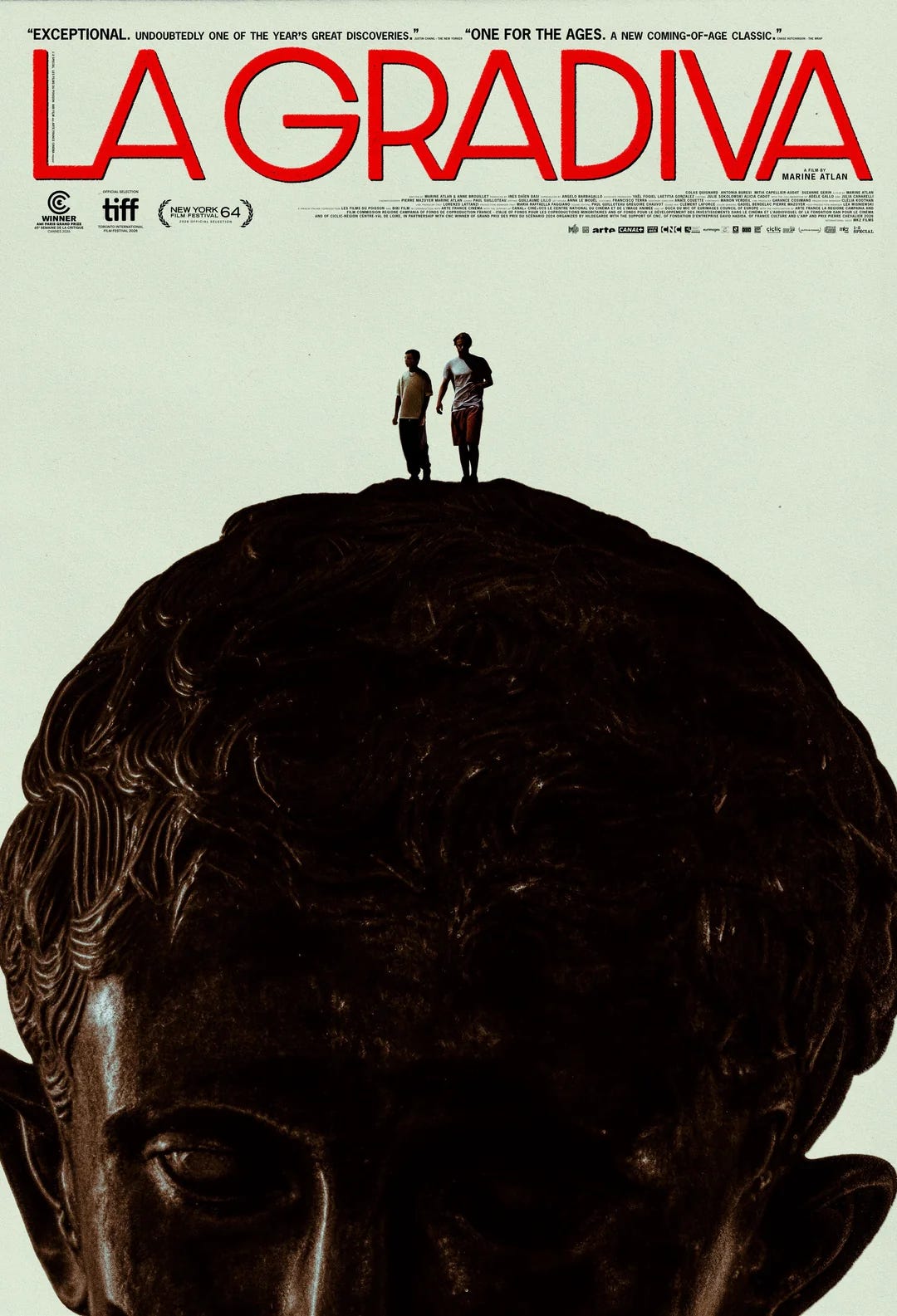
Marine Atlan’s debut feature, La Gradiva, is nothing short of a masterpiece. Following a group of French students on a school trip to Pompeii during their final year, Atlan uses Mount Vesuvius as a metaphor for the burgeoning adulthood of her ensemble cast: all that pressure slowly building beneath the surface, waiting for the inevitable eruption.
I’ll forgive the comparison for being so obvious because the film itself is anything but.
La Gradiva makes space for its enormous ensemble—almost entirely composed of non-actors in their first roles—to exist as real, complex, authentic people. At times, the film feels less like a drama than a documentary, an effect aided enormously by the astounding camerawork Atlan brings to the film while serving as her own director of photography (a role she’s honed in her prior work).
The tragedy of Pompeii may be an obvious metaphor, but Atlan slowly builds upon it until the film brilliantly re-contextualizes much of what came before. More importantly, it is the room she gives these characters to simply breathe that elevates La Gradiva beyond the typical coming-of-age story. It’s no surprise the film won the Critics’ Week Grand Prize at the 2026 Cannes Film Festival.
Our primary group is anchored by Toni (Colas Quignard), a lost soul searching for some sense of meaning while confronting generational trauma that increasingly feels impossible to overcome. His best mate, James (Mitia Capellier-Audat), exudes an almost indiscriminate erotic tension with everyone around him and couldn’t help but remind me of Nicholas Hoult’s Tony Stonem in the now decades-old (and still brilliant) British series Skins.
They are joined by Suzanne (Suzanne Gerin), the quiet girl who can’t quite confront why she wants what she wants, seemingly biding her time until she can finally escape. This trip culminates in the student’s admission to college - the real next step into adulthood.
Then there is Madame Mercier (Antonia Buresi), their teacher and the only traditional actor among the principal cast. She serves both as a stand-in for an audience suddenly confronted with the complicated age-gap dynamics unfolding around her and as a woman reckoning with what it means to grow older in a world changing faster than she can entirely understand. She so desperately wants to help, but simply does not have the tools to make a real difference.
The rest of the cast is just as strong, and Atlan finds a way to give almost everyone a moment to shine. Even with limited screen time, she never shies away from the complexity that makes these characters feel so alive. The film moves through class, race, sexuality, love, money, generational trauma, and seemingly everything else that can make growing up feel impossibly overwhelming.
Maybe “feel” is doing too much work there. Growing up actually is that overwhelming.
Coupled with the film’s hyper-realistic dialogue, Atlan’s documentary-like approach creates the sensation that we aren’t watching characters so much as briefly being allowed into their lives. Beneath that naturalism, though, is an incredibly compelling story about how we find our place in the world, the tensions that arise as we discover it, and both the responsibility and consequences that come with truly seeing—or failing to see—one another.
I don’t want to spoil much, but La Gradiva is a tragedy through and through.
In one scene, Madame Mercier presents the class with a plaster cast of one of the many people who died during the eruption of Mount Vesuvius. The students spend time wondering what might have been going through this person’s mind: what they were thinking, what they understood, and what they felt as catastrophe unfolded and ultimately consumed them.
It is the same role Atlan asks us to play as an audience.
What does it actually take to see another person?
La Gradiva ends on a note of tragedy and regret, and by that point you can’t help but feel implicated in whatever failures its characters are guilty of. We have been watching them this entire time. We have seen the glances, heard the comments, noticed the tensions, and perhaps dismissed some of them as inconsequential because we did not yet understand where they were leading.
But the smallest words and actions can leave the largest marks on another person.
That is what makes the Pompeii metaphor ultimately work so well. The catastrophe itself may be enormous, but what remains afterward are the smallest traces of individual lives: a posture, an expression, a final moment frozen in time. Atlan’s gorgeous tableaux can similarly make it easy to become consumed by the beauty of the larger picture while losing sight of the individual people standing within it.
La Gradiva asks us to look closer.
By the time we finally do, it may already be too late.
La Gradiva plays in NYC and LA in December.
The Unknown
1.5/5
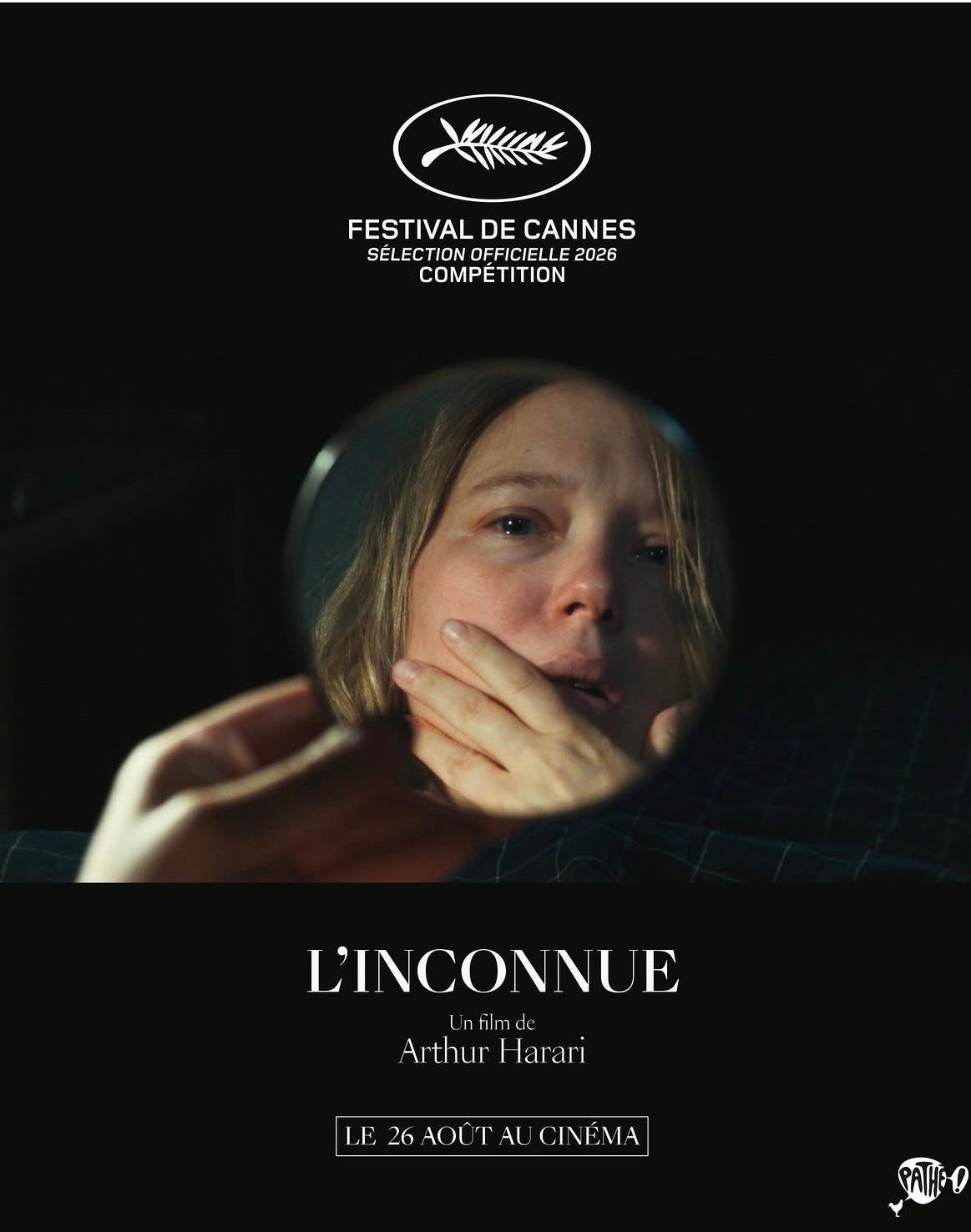
Arthur Harari’s The Unknown unfortunately has the distinct honor of being my first—and hopefully only—major disappointment of the 2026 New York Film Festival. Harari, co-writer of Anatomy of a Fall, commits the cardinal sin of squandering a remarkably compelling premise on a dull, lifeless film that somehow feels two hours longer than its already punishing 139-minute runtime.
On its surface, The Unknown is a body-swap pseudo-horror comedy featuring excellent performances from Léa Seydoux as Eva and Niels Schneider as David, two strangers who appear to swap bodies following a mysterious hookup at an art show/performance venue.
Clearly, something strange is happening. Whatever passes between them behaves almost like some horrific supernatural—or even alien—STD, but the film remains deliberately opaque, refusing to provide any concrete answers.
Which is fine!
Great art frequently invites interpretation. Ambiguity is not the problem. The Unknown fails because it is only capable of asking questions without ever digging into what makes those questions interesting in the first place.
For all the comparisons to David Robert Mitchell’s It Follows, this is barely a horror film in any traditional sense. I found Jonathan Glazer’s Under the Skin a much more appropriate comparison. But where Under the Skin succeeds through absolute confidence in its tone and ideas, The Unknown seems content to borrow similar imagery and provocations without engaging with them in any remotely compelling way.
As Seydoux and Schneider embody different versions of Eva and David, their performances provide the movie with just enough momentum to maintain some semblance of your attention. Ultimately, though, their excellence only made me more frustrated. These are fascinating performances trapped inside a movie that simply does not deserve them.
Seydoux, in particular, is almost always worth watching, and I’d happily redirect anyone disappointed by this film toward the criminally underseen The Beast (La Bête), Bertrand Bonello’s decade-spanning masterpiece.
There are moments throughout The Unknown when it appears on the verge of doing something genuinely special, but those moments become almost as infuriating as the performances themselves. Every flicker of inspiration only serves as another reminder of how listless the larger endeavor remains.
The body-swap premise practically begs the film to interrogate identity, gender, sexuality, bodily autonomy, intimacy, and the unsettling experience of inhabiting a body that is simultaneously yours and not yours. The Unknown brushes against several of these ideas, but its pacing becomes a major obstacle to ever exploring them with any depth. Interesting concepts finally emerge far too late, only for the film to abandon them almost immediately.
The score suffers from a similar problem. There is the foundation of something genuinely evocative there, but the film refuses to build upon it. Again and again, The Unknown introduces something potentially fascinating and then simply leaves it sitting there—a pattern that perfectly encapsulates my frustration with the entire 139-minute runtime.
The film gestures toward gender, trauma, family, and political extremism, and I found there to be a potentially interesting far-right conservative reading buried within it—pay attention to the artwork in the background of the opening scene. But even that ultimately feels more provocative than purposeful. The imagery suggests an argument the film never seems willing to articulate, much less interrogate.
That unwillingness becomes the movie’s defining characteristic. The Unknown exudes a strange lack of confidence, as though Harari is afraid that committing too strongly to any one interpretation might diminish the film’s mystery. Instead, that hesitation slowly suffocates whatever tension the movie manages to generate.
Ambiguity can make a film feel enormous. Here, it makes The Unknown feel hollow.
Despite what might be the greatest needle drop of the year—two words: The Weeknd—The Unknown is a total bore. It somehow manages both to distrust its audience and, by the end, feel as though it actively resents us for wanting anything meaningful from it.
The Unknown releases by NEON in 2026 in the U.S.