

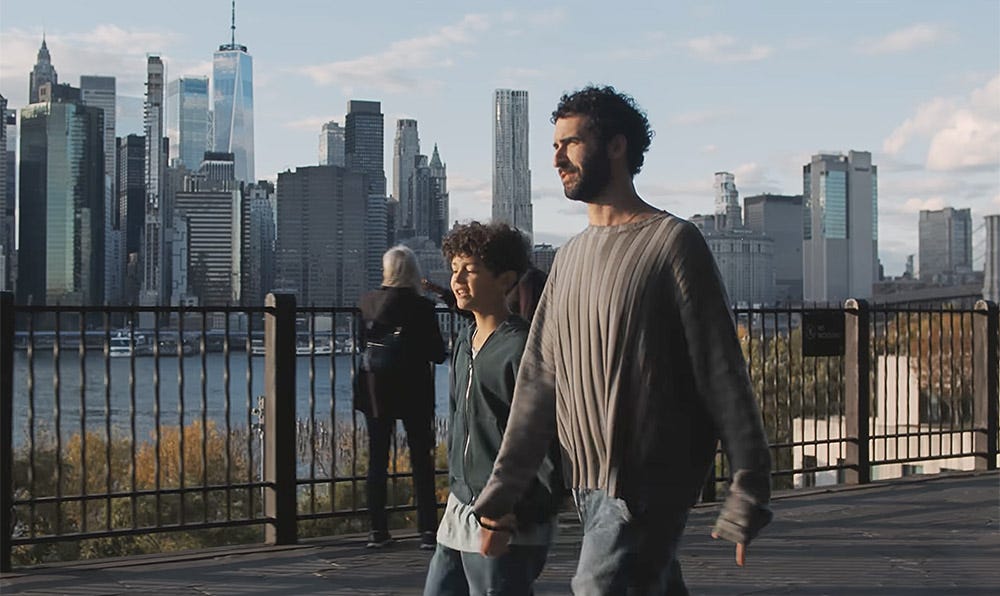
Jordan Firstman’s directorial debut, Club Kid, knows how to pull on your heartstrings, but only in the shallowest of ways.
Firstman plays our protagonist, Peter, a gay 20-something, then 30-something, who practically owns NYC club culture through drugs, sex, and low self-esteem. His world is flipped upside down when, 10 years after a threesome gone wrong (and hardly remembered), Arlo (Reggie Absolom) shows up on his couch. Arlo is his son from this ill-forgotten tryst, and Peter is the only parent he has left.
Club Kid is frequently funny (“fucking bitch” will forever be memorable), but beneath this comedic facade is the shallowest of coming-of-age stories. Peter has to get his life together now that his responsibilities extend to his own child, and the film continues on as predictably as you might expect. To Reggie Absolom’s credit, Arlo anchors the whole film. He’s boisterous but shy, balancing charm and edginess. He’s a lost kid finally feeling seen in the same way that Peter also finally feels understood.
But Absolom’s performance does not excuse the chore of a script Firstman has penned. The film fails to deliver anything deep or meaningful, instead presenting a straightforward narrative more akin to a Hallmark movie than a prestige drama (which it seems to think of itself as, given the overwrought filmmaking that proves Firstman can cleverly copy style but can’t develop it himself).
In one performatively poignant scene between Peter and Arlo, the script falters as Firstman feels the need to explicitly name the subtext. This is not clever commentary, but rather an insult to audiences everywhere. This egregious example is but one of many (don’t even get me started on the first date with the entirely superfluous Diego Calva).
Most surprising, frankly, is how downright offensive I found the film. More than tinged with conservative moralizing, the film doubles down on the sinister lifestyle that Peter has lived and must wholly reject to become a worthwhile human being. I’m not defending many of this character’s actions, but the film is unwilling to engage with the complexities evident in all of us and would rather tie a neat bow to give Peter an all-too-happy ending that feels more like a devious critique of the LGBTQ community than any sort of transformational, empathetic change.
This is driven home in some truly atrocious ways. All Black, queer, trans, and fat characters are cast aside so that Peter can achieve his new goal of fatherhood.
The movie will move you, but not because the movie is good—because it knows how to play on basic emotional beats anchored by truly one of the cutest kids you’ll ever see. Reduced to punchlines (and further into punching bags), this is a privileged white narrative through and through, and I am shocked by the positive critical reception.
One character, Nicky (Eldar Isgandarov), is the most egregiously targeted here. An unwanted roommate who inexplicably changes from a refugee clown to a literal straight ally, he is one of the few characters who appears to “grow” alongside Peter throughout the film. Firstman is a gay man who seems to be only capable of using his queer kin as caricatures and, you know what, I will talk about Diego Calva.
Maybe one of the most infuriating characters in the entire film. Calva plays Oscar, Arlo’s social worker, with whom Peter develops a romantic relationship, going so far as to effectively court one another in the most traditional sense. Firstman jammed a Hallmark movie in here with a character who serves almost no purpose.
He appears to be the antithesis of Peter’s former gay life but seems to be blatantly ignorant of the consequences ultimately facing Peter. This love interest is even more egregious when another character is literally set up to be Peter’s love interest, but I guess Devon (Nigil Whyte) is too fat and too Black to serve this script’s purpose.
This is a story of a man who finds redemption in rejecting his queer identity—in assimilating to heteronormative culture. At multiple points in the film, Peter is asked to thank those oppressing him (the judge, Arlo’s legal guardian), and he gladly follows along and thanks them for it. Club Kid is a downright shallow film, and the deeper you dig, the more grotesque it becomes.