

Behemoth! 3/5
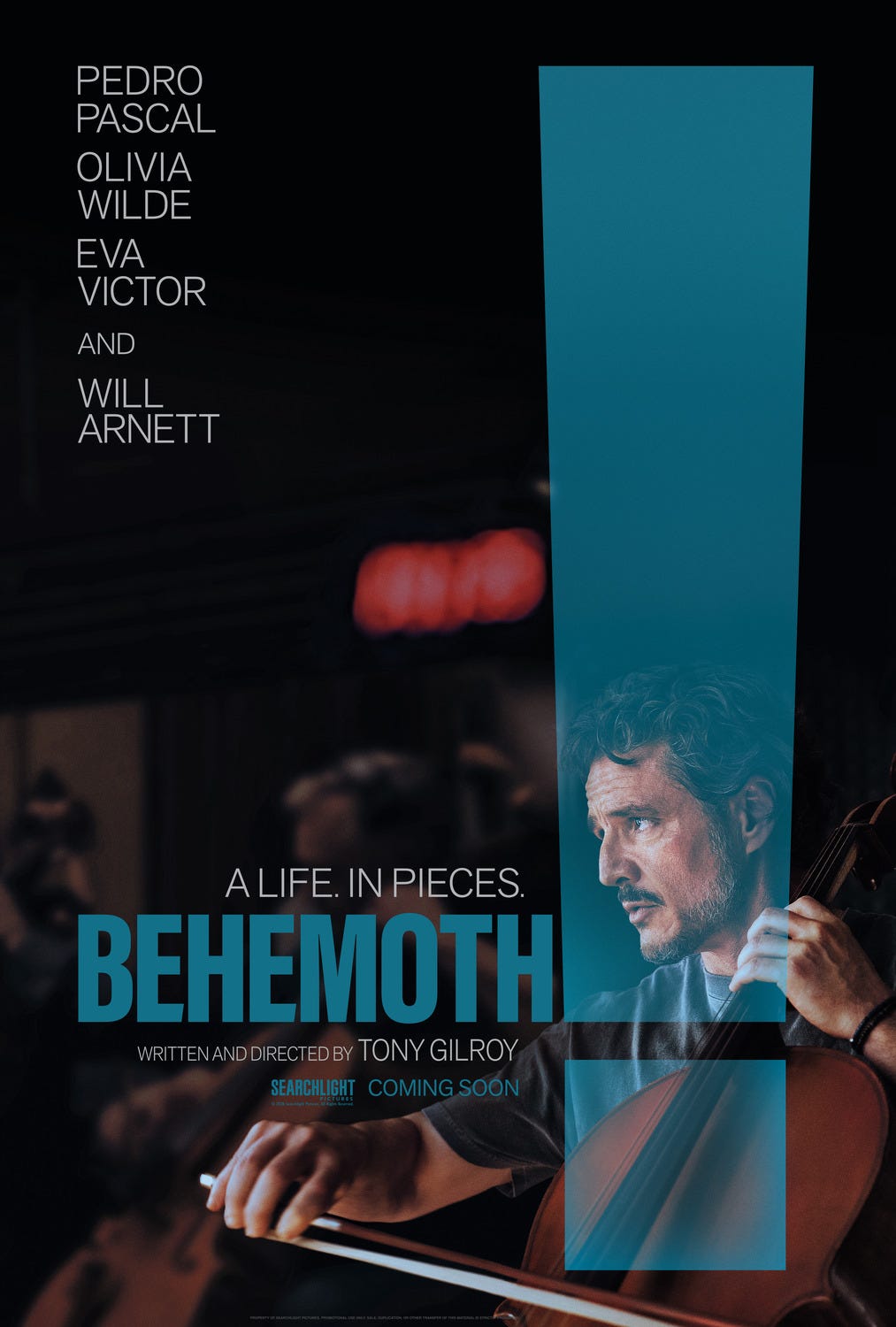
Tony Gilroy directs Behemoth! like an action movie—if only the film moved more like one. Starring Pedro Pascal as Alex Serian, a renowned cellist playboy searching for something deeper, the film asks Pascal to carry an emotional core that is largely nonexistent in this sprawling, nonlinear drama. Unfortunately, I don’t think he has the chops to manufacture what the script itself cannot provide.
Flanked by another one of Olivia Wilde’s über-memorable performances (seriously, can we nominate her three times for an Oscar? Behemoth!, The Invite, and I Want Your Sex have all floored me from the Wilde perspective), and a hilarious turn by Will Arnett as Alex’s equally troubled brother, the Pedro Pascal of it all really does not work for me. I’ll confess I am not a fan, but in a world where we can lose the world’s greatest living movie star (Tom Cruise) in the character of Digger Rockwell, I’d implore you all to ask for more from our leading actors.
Pascal is not totally at fault here, though. It’s the writing of Behemoth! that really fails him. Jumping years between scenes, there is no rhythm to these arguably strong tableaux that Gilroy can direct the hell out of but cannot imbue with the pathos required for a story like this one. And Gilroy does direct the heck out of this. The opening scene is thrilling, and there’s a stunning sequence that feels like we’ve been transported into a Bond film (even if the stakes are admittedly lower).
This great directing is accompanied by a truly stellar score. Composed by the Behemoth Collective (an absurd collection of all-timer composers including Alan Silvestri, James Newton Howard, Michael Giacchino, and others), the music is unfortunately attached to such an underwhelming film. And while this score feels like its own form of Oscar bait given the collaboration and pedigree, I am generally unopposed due to its incredibly high quality. The orchestra is deeply moving, and when the film takes time to inject the score directly into the story, I found glimpses of the emotion the film desperately wants you to feel—even if it can’t quite pull it off any other way.
Which is all to say: great direction, an incredible score, and strong supporting performances can only do so much for an underbaked script. This drama spans decades of family trauma and the ongoing indignities and challenges of simply living, but nothing lands with the impact it really deserves. The nonlinear structure seems designed to create mystery and emotional accumulation, but instead it keeps resetting the film before any of these relationships can truly take hold. I’d argue this is worth watching alone for Olivia Wilde’s 10 incredible minutes of screen time, but they’re surrounded by nearly two hours of a film that never quite earns the attention it continually demands.
Everytime 4.5/5
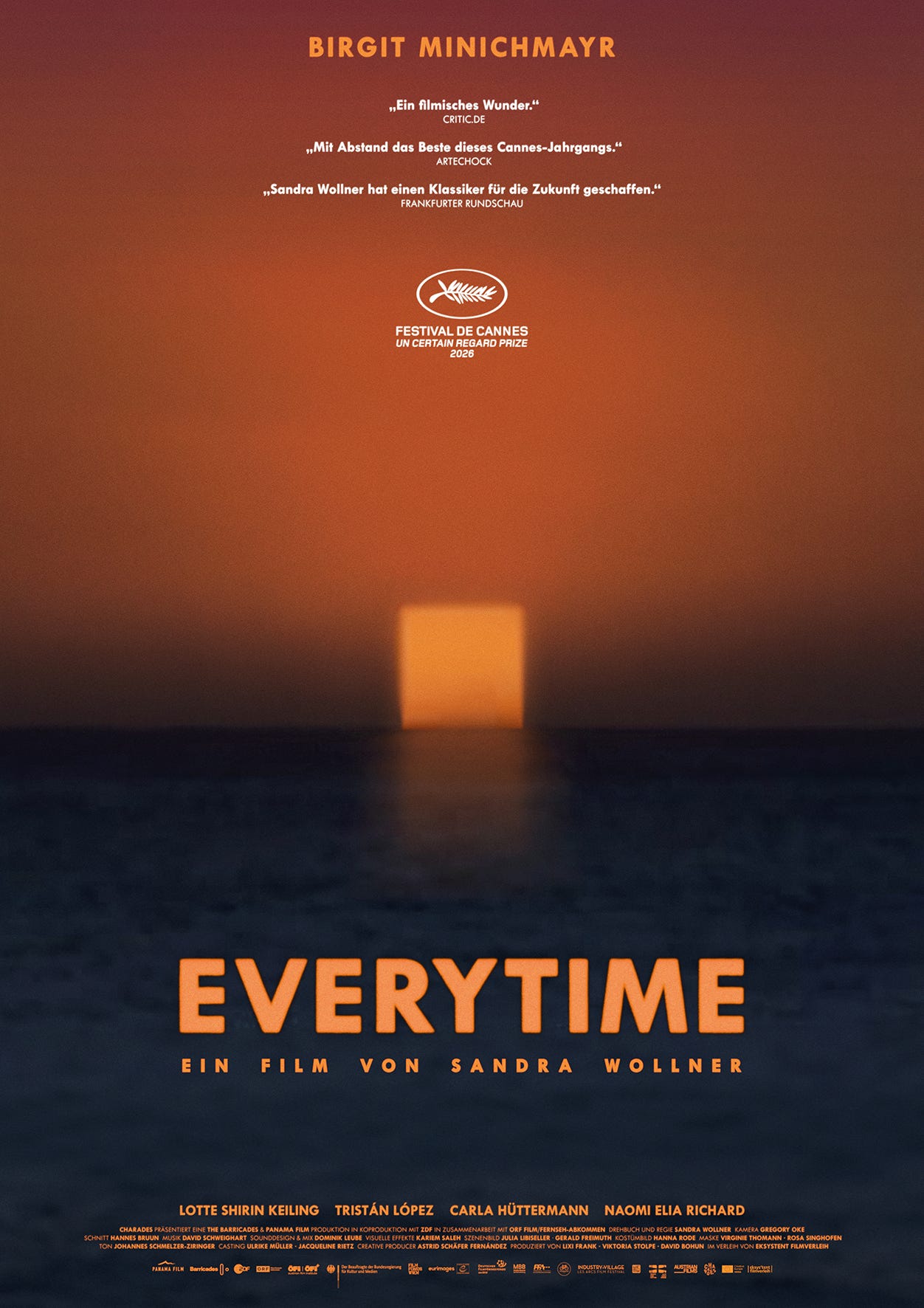
Everytime might have had a more fitting title in Aftersun, but that is unfortunately already taken by Charlotte Wells’s Paul Mescal-starring masterpiece. Similar to Aftersun, Everytime is a film about grief, and I’ve struggled to write about it without returning to that comparison because these films feel like spiritual siblings, though there is no formal connection between them.
Everytime tells the story of Ella (Birgit Minichmayr), Lux (Tristán López), Melli (Lotte Shirin Keiling), and Jessie (Carla Hüttermann), all delivering powerhouse performances, as they live through one of the worst experiences of their lives—the inexplicable death of someone dearly beloved.
I won’t spoil more than that—though this could hardly be considered much of a spoiler. The film, even in its less obvious moments, is overflowing with tragedy. And while it is incredibly challenging to watch, I found the slow shift from the literal to the surreal to be an utterly compelling representation of grief: the impossible process of learning to live alongside it and discovering what, if anything, can emerge on the other side.
Accompanied by a magnificent Minecraft-inspired score by David Schweighart, nearly everything about Everytime just works. This is most apparent in a truly haunting third-act turn (also reminiscent of Aftersun, though nonetheless effective) that recontextualizes the entire film right up until its final moments, leaving you wondering how the hell Wöllner managed to pull the whole thing off.
Certainly not for everyone, keep this film in mind if you need a good cry—or are far enough away from your own grief that you can find some comfort in seeing the experience represented in a way you likely never have before. I can’t help but recommend it. The best art moves us, and I found myself deeply moved by this unlikely group of people drawn together for the most horrific of reasons, only to discover some measure of comfort in one another anyway.