

What’s the worst thing you’ve ever done?
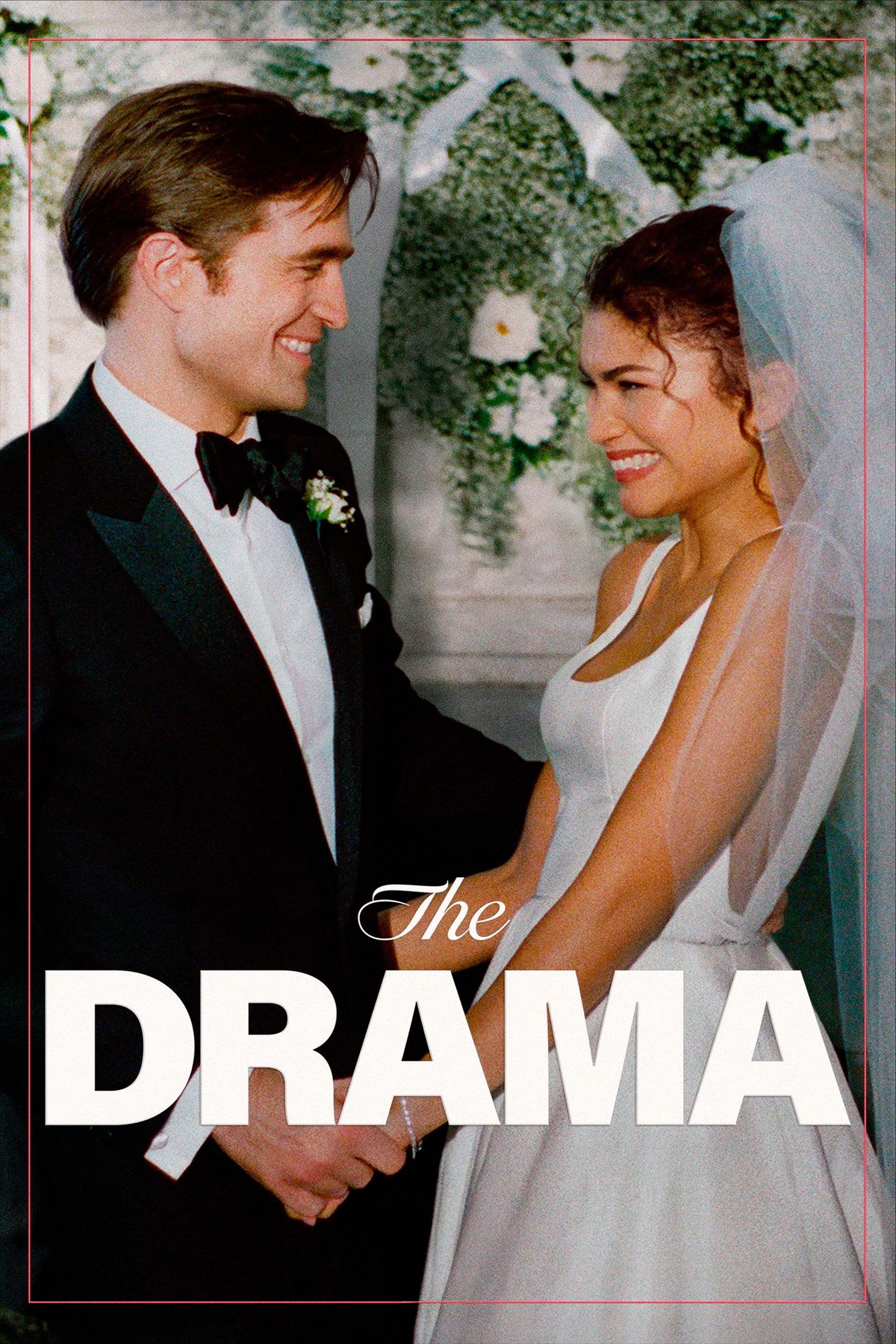
Kristoffer Borgli’s The Drama starts out innocuously enough. We meet Charlie (Robert Pattinson) and Emma (Zendaya) recounting the beginning of their relationship as they work through their vows with their closest friends. This film is all about perception, and that is abundantly clear as we see the realistic ways many of us may, on purpose or not, choose to misremember the past in order to tell a better story for the present. This is our first subtle inkling that something is awry, with Charlie and Emma’s meet-cute perfectly bordering the line between romantic and creepy. Charlie, you see, is presented as a bit of a sheepish romantic, quickly sneaking a peek at the book Emma is reading and pretending to have read it to break the ice. This is innocent enough, but it colors how these little lies can become so integral to the stories we tell ourselves.
To Emma’s credit, she picks up on this lie pretty quickly, and Charlie comes clean on their first date. Emma is willing to pass this off as a romantic gesture, not a mischievous one, which reminded me of the old adage: it’s only creepy if someone ugly does it. Pretty privilege points go to you, Mr. Pattinson. Her empathy around lying becomes more understandable when we find out Emma has been keeping a pretty big secret for a very long time.
Before I get to spoilers, which is necessary given how integral this premise is to the ensuing acts, I have to say this is one of the best films I’ve seen in 2026. The Drama is the ultimate cringe-fest, played beautifully by Charlie, who really is the center of our story. Charlie and Emma, along with their two friends Rachel, played by Alana Haim, and her husband Mike, played by Mamoudou Athie, embark on a mission to become the most unlikable characters you are likely to see on screen in a while. I laughed frequently, mainly out of discomfort, and the film hits all the right notes to build tension and relieve it.
But what was most surprising to me is that the film delicately balances these unlikable characters and preposterous situations with real heart. I found myself deeply moved by the end and, for as much as the film sets up the imperfect ways these characters interact with one another, it’s the empathy on display that truly took me aback. There are a couple of hilarious moments in the film where empathy, the word literally, is front and center. One is when Zoe Winters, in a dazzling portrayal of the world’s best-worst wedding photographer, asks Charlie and Emma to say what they love most about each other. Double empathy. Love it. There is also a scene where Charlie specifically deletes the word empathyfrom his wedding speech. So as much as the film wants to shock you, and it does, there’s something deeper and rawer that elevates it far beyond where you think it will go. It’s one thing to make a film where the audience can snidely judge all the characters and walk out with an inflated sense of self, but the film doesn’t think so little of its audience. It forces you to see yourself in these characters, who are the opposite of inspiring, and empathize with them in a way that we so rarely seem capable of extending to one another.
With that said, let’s talk spoilers. At the food tasting with Rachel and Mike, which, by the way, the film inexplicably seems to be totally unaware of the mechanics behind planning a wedding—you are deciding on food literally a couple of days before the wedding? This is not the last or even the most egregious example—they bring up this “game” they played before getting married in which they told one another the worst thing they had ever done. You see where this is going. It’s played for laughs, but we all know something darker is about to happen, aided in no small part by the free-flowing wine from our caterer. Mike gives a kind of nothing-burger of an answer: he used his ex-girlfriend as a human shield against a feral dog in Mexico… on her birthday. Rachel shares what was, in my opinion, maybe the most egregious answer of them all: as a child, she trapped a young disabled child in a closet in the middle of the woods and left him there overnight, resulting in a formal police search, where he was found, ostensibly unharmed but likely traumatized. Rachel excuses this later in the film as a simple impulse, and this ultimately makes for one of Alana Haim’s most memorable roles yet. Charlie seems unable to come up with much of anything, admitting half-heartedly to cyberbullying someone as a kid, though this feels either completely fictional or largely embellished, and then attention turns to Emma. Our sweet Emma admits to planning a school shooting as a teenager, going so far as to bring the gun to school and use a webcam to record a manifesto, in a scene that nearly had me in stitches, where her computer errors out multiple times while trying to record. Rachel is the first to turn, mouth agape in disbelief, and immediate judgments are hurled across the table.
There’s no going back now. We are all on this roller coaster, and the next 70 minutes are a ride you may desperately want to escape. Charlie completely deteriorates. This is really his film, his descent into madness, as this one truth upends everything he thinks he knows about his future wife. It’s this play on truth versus lies that really gets at the film’s core.
While Emma is truly empathetic, easily dismissing Charlie’s lie that is the foundation of their relationship, Charlie is not so skilled in this realm. After the couple sleeps on it and reconvenes the next day, what stuck out to me most was Charlie’s immediate line of questioning. He asks two things of Emma. First, was that true? But second, and most damningly: why did you say that in front of everybody? And that is what gets at the thesis of the film. It’s not about what she did or didn’t do—which, by the way, she didn’t do, but Rachel fully abused and traumatized a neighbor—it’s about the fact that other people know, and now this is a thing that needs to be contained. Which, of course, it isn’t, and Charlie knows this. Lies have a way of catching up with you. Whether it’s on a first date or at a wedding, whether they are little white lies or big secrets that have never been said before, they impact everything we do, and that burden is unlike anything else.
Charlie would not be described as double empathetic. He can’t stop thinking about this revelation, and it shows up in hilarious ways. Rachel and Mike are unable to drop it, with Rachel threatening to drop out of the wedding and needing to confirm with her cousin Sam, paralyzed from an implied school shooting, that she has permission to attend this wedding, in a wonderful play on Rachel’s performative nature that feels deliciously more evil than anything any of our other cast members do. Charlie finds lying easier, and he lies to everyone. He lies to Rachel and Mike about why Emma did this, making up some story about Emma witnessing her best friend killed in a car accident and having untreated trauma, wonderfully highlighting how there seems to be some imaginary bar folks need to clear in order to earn empathy and understanding from one another. He also ends up cheating on Emma with his coworker Mischa, played by Hailey Benton Gates. Seriously, she and Zoe Winters are competing for the best supporting roles here; everything they do is some of the funniest stuff I’ve ever seen on screen. Charlie, as we come to expect, does not go through with it all the way, but his one and only line to Mischa after the almost-affair is, “Please don’t tell anyone about this.”
Charlie still has a preoccupation with how he is perceived, which is so ingrained it has even shaped his career as Head of Curation at a museum, and he does not apologize to Mischa at all. He just wants to protect himself by hiding who he is and continuing to lie so that his perfect facade remains unblemished, even if he is perfectly willing to confront other people about their lies and act aghast when they refuse to admit to them.
And this is where I have my only real criticism of the film. This is really Charlie’s journey, but it’s not quite earned. I’ve gone back and forth on this, and I’ve landed on the fact that it is not so egregious that the rest of the film doesn’t work, but his transformation is too subtle for me. When Emma and Charlie are eventually reunited after the wedding blows up in spectacular fashion—don’t worry, our wedding photographer never stops shooting—I was less convinced than I wanted to be that Charlie had changed and realized the error of his ways. Rachel, despite going through it, proves to be more than double empathetic.
Her hidden past has shaped her into being divinely understanding. She knows just how terrible people can be—she came pretty damn close herself to being the worst version of herself possible—and so she doesn’t have the same hang-ups around perception that everyone else has. I mean, I never thought I’d see a film turn almost committing a mass shooting into an emotional superpower, but here we are, and it actually works. So in the end, after everything Charlie has done—it should be said that Rachel, for her part, has not really done much of anything at all, simply committed the cardinal sin of almost doing something terrible—Rachel’s acceptance feels maybe a bit undeserved, but it ultimately aligns with what we know of her character.
And that final scene did deeply move me. The film captures how nobody really knows anybody. We all have lies and secrets, and certainly nobody really knows what is going on behind the scenes in someone else’s marriage. But for all of that, our ability to empathize with and love one another despite all our flaws is what makes that commitment, and that love we share, so meaningful. It’s a pressing reminder to stop chasing aesthetics and focus on what’s real. Even if it is messy and painful at times, it’s all we have, and we are darn lucky that this is something we are capable of.
By the way, some of my favorite moments in the film:
Emma sharing the specifics of what defines a mass shooting or not. It’s 4 or more, by the way.
The photographer’s “Shot” list. Grandparents TBD.
“Smile completely naturally… like in real life”
Everything about the replacement DJ
“Call the police”
Blake
“You grew up around guns”
Just saw it, this is a beautiful read!!! I think you’re exactly right about all of it. It’s all about performance and perception, and Emma was actually the least problematic of the bunch!!!