

A FLEET
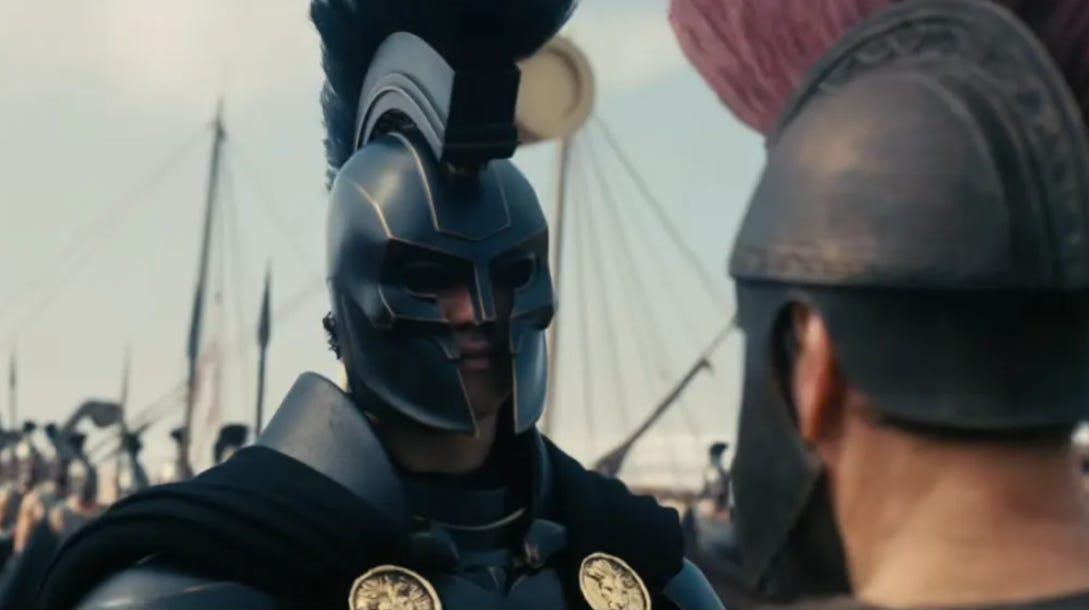
Christopher Nolan’s The Odyssey is an epic in every sense of the word. Spanning almost three hours and taking place over decades, it is the first Nolan film that, to me, has felt constrained by the limits of cinema itself. Nolan himself seems to agree, given his decision to film the entirety of The Odyssey on IMAX—a feat that has never been accomplished before and required the development of a brand-new 65mm IMAX camera, appropriately named after David Keighley, IMAX’s late Chief Quality Officer.
The development of new technology to capture Nolan’s vision for one of the world’s oldest stories is triumphant. It reminds me of the dual role James Cameron has played in advancing CGI throughout his film career, particularly through the development of the Avatar film series.
These directors are visionaries through and through, and I don’t think it’s a shock that this approach has translated into enormous box-office success. In a world rapidly filling with AI slop, people yearn for authentic work that only a human can make. For a story that has been retold across generations, it’s fitting for Nolan to lend his vision to this definitive take on the character of Odysseus.
A WAR
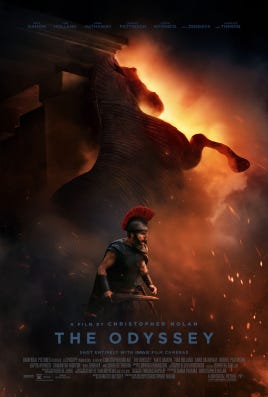
The Odyssey, though, is not without its faults. It’s nearly impossible to follow a masterpiece like Oppenheimer—though, if anyone could do it, it’s certainly Nolan—and perhaps my expectations were as lofty as the cameras used to shoot the film. Still, I did not find Nolan completely successful in translating this epic text onto the big screen.
I should note: these critiques are minor. This film is a stunning achievement on both technical and storytelling levels. Nolan perfectly builds upon his penchant for nonlinear storytelling—pioneered in Memento, perfected in Tenet, and honed further in Oppenheimer—smartly utilizing the time Odysseus spends with Calypso as a vehicle for jumping among the story’s set pieces.
And while this nonlinear storytelling never detracts from the story itself, I did find the pacing just a bit rougher than Nolan’s usual crescendo into an all-timer of a third act—which we still get; it’s just a little bumpier getting there.
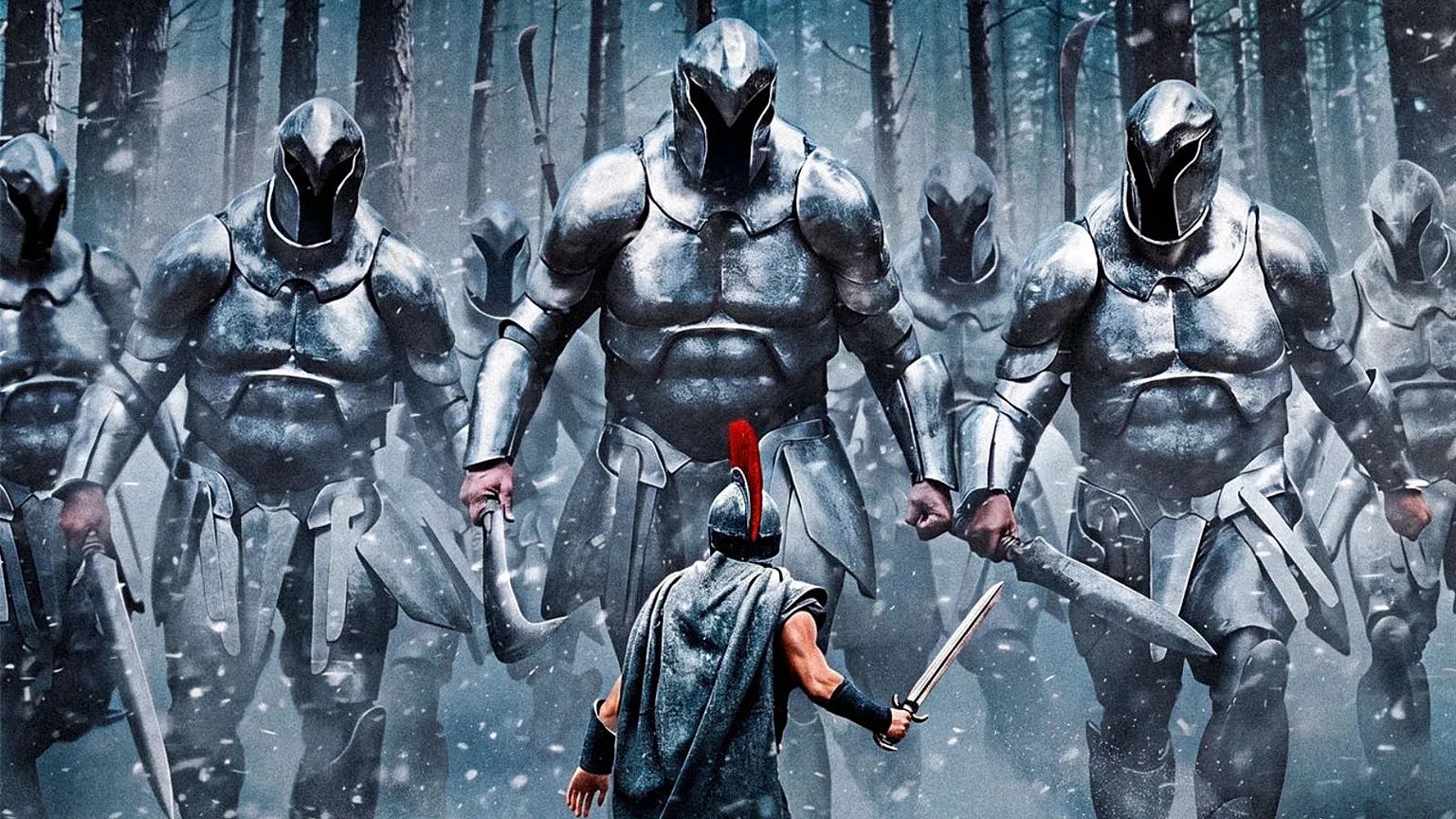
Nolan’s choices in this well-known story generally worked for me—from the Cyclops to the fall of Troy—but a number of sequences feel rushed. The moments themselves are compelling, but the audience has little time to sit with them or react before we jump to the next key moment in Odysseus’s journey. Both the battle with the Laestrygonians—which shows the ultimate hero of the Bronze Age being witlessly outclassed by the coming Iron Age—and the devastation of Scylla, one of many impossible choices Odysseus is tasked with making, unfold too quickly. We breeze through some scenes while still feeling their impact—the Sirens, for example, in a sequence that reinforces Nolan’s Christian reading of The Odyssey, with Odysseus undergoing this story’s version of Christ’s crucifixion—but these sequences feel too rushed. Nolan would have been better off either omitting or expanding them.
A MAN
Matt Damon’s Odysseus is the heart and soul of this film. The king of Ithaca, the mastermind behind the Trojan Horse, and the quintessential hero of the Bronze Age, he is also Nolan’s most unlikable protagonist—and Damon is perfect. Peeling back the layers of the myth, Damon captures the character’s humanity, including all the incongruities and faults therein, better than any other rendition of Odysseus. He has been depicted as both a hero and a villain, but Damon manages to delicately balance the two, finding someone all audiences can root for despite his obvious faults.
This epic only works, though, because of the stellar cast surrounding Damon. It’s nearly impossible to go through everyone, and while some performances are weaker than others—Charlize Theron, Travis Scott, and Jon Bernthal—none are bad. A few, however, stand out and deserve additional accolades.
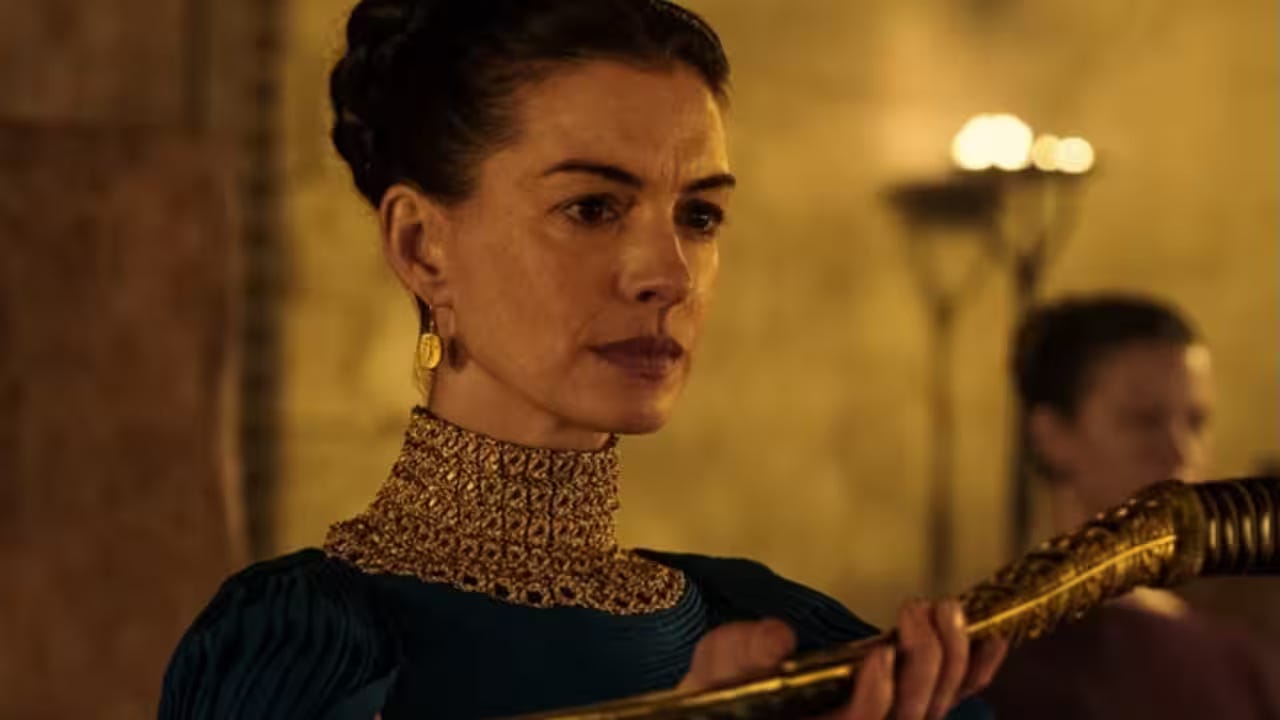
Anne Hathaway is wondrous as Penelope. As Odysseus’s isolated wife, she has one specific monologue to Tom Holland’s Telemachus articulating the unacknowledged role she has played in her husband’s absence that is so profound and so moving. She somehow captures the entirety of the feeling that so many women who have stood beside—or behind—“great” men experience and rarely receive credit for.
Tom Holland, too, is excellent as Telemachus. Of course, we know Holland can play a puckish, if immature, boy in Peter Parker, but the film gives him one particularly standout moment in the third act. The parallel journey Telemachus has been on finally reaches its end, and he must silently compose himself because the journey now colliding with his own requires just a bit more of him.
Robert Pattinson eats up the screen as the sleazy Antinous. In a role that is already being memed across the internet—“Somebody get these beggars out of here”—it is both the fun Pattinson has as this delightfully evil character and the character’s pathetic nature that make him infinitely watchable. Seriously, at one point, he kicks an elderly dog and then places him on a pile of feces seconds later. Pattinson presents Antinous as a strategic man masquerading as confident, brilliantly capturing the underlying tension between his outward façade and internal doubt. He’s not someone to root for, but I’ll be damned if I did not love every second of his time on screen.
Samantha Morton reportedly received applause on set while filming her scenes as Circe—and deservedly so. Perhaps the most compelling character Odysseus meets on his journey home, Morton injects an entire unseen story into the role, one never shown on screen but felt deeply through her character. She deserves a movie of her own and serves wonderfully as the linchpin of our understanding of Odysseus and his men, highlighting the sheer absurdity of their quest.
A THOUGHT
The larger theme echoing throughout the film is Zeus’s law, or xenia, which Nolan molds into the commonly understood Golden Rule—treat others as you would want to be treated—with a slight bend rooted in the Greek gods themselves: extend hospitality because the gods may take any form.
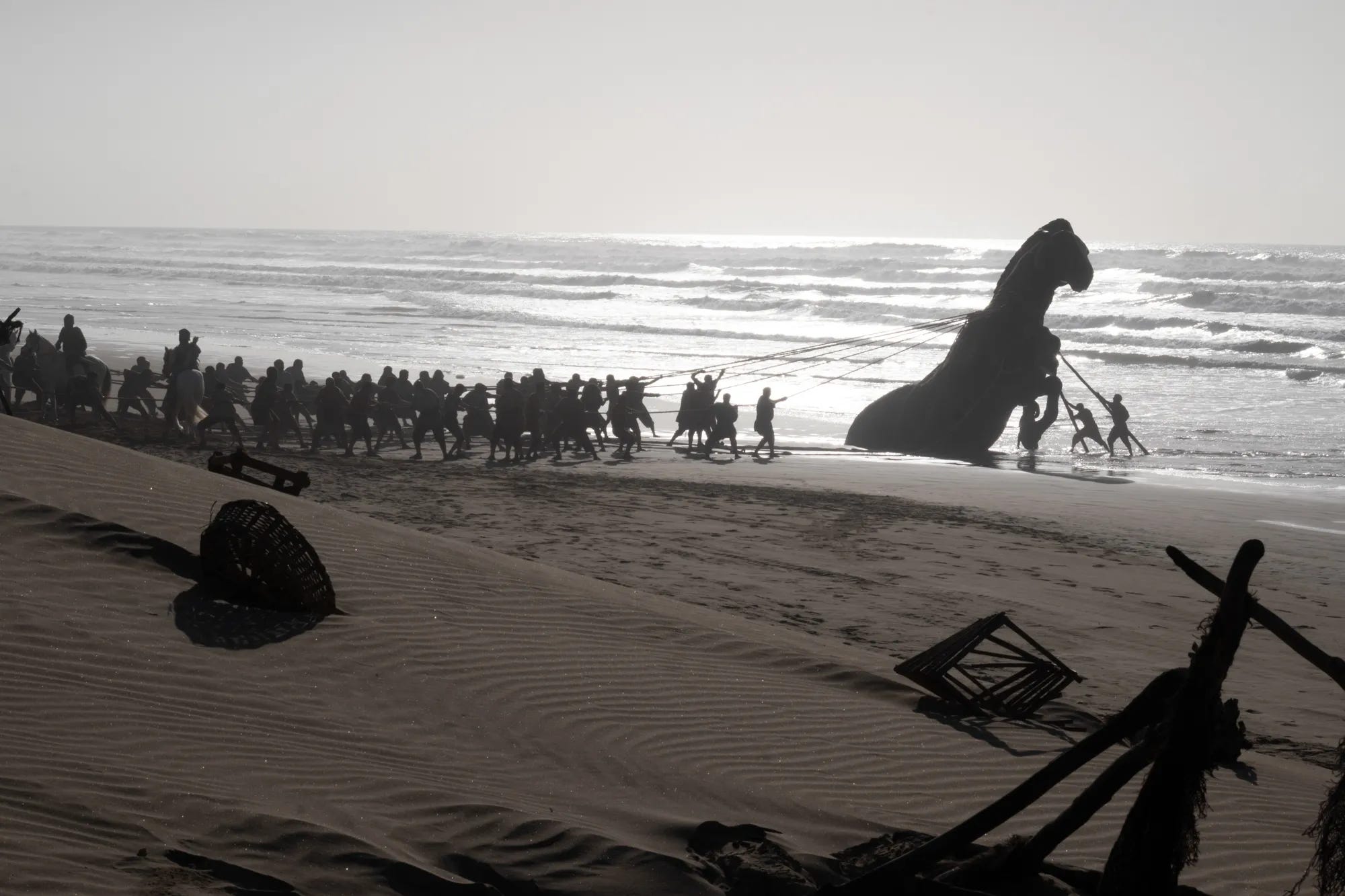
This thematic throughline anchors the film. From Odysseus’s men requesting accommodations along their journey to Penelope entertaining suitors in the halls of Ithaca, there is a clear moral core to this story. Its violation in the most profound of ways—the Trojan Horse—has tremendous consequences throughout the entire world.
Odysseus is a hero, but at what cost? The film wrestles with the idea over and over. Do the ends justify the means? Frankly, how could they after what we witness over a brisk 172 minutes? Odysseus is incapable of returning to his homeland until he reckons with what he has done—an act that took mere hours but that he comes to terms with over decades of tragedy and defeat. A hero known for plucking his bowstring to provide a fair fight for any prey he stalks, his actions at Troy violate xenia on both a micro and macro level.
A TRICK
When Odysseus and his men end up on the shores of Hell, confronted by the men they have lost, it all becomes clear. What has all this been for? How do we occupy ourselves with these superficial and frivolous conflicts, ultimately meaningless in the face of inevitable death?
At the steps of Hades, Tiresias—in an incredible turn by James Remar—reveals the divine doom awaiting Odysseus and his men. This journey is about Odysseus overcoming his faults and atoning for his sins, but none of his men are lucky enough to endure that torture and emerge from the other side.
This scene echoes the larger themes at play. We may be following one man’s journey, but the violation of xenia extends far beyond the literal act of the Trojan Horse—it has ingrained itself deep within the souls of Odysseus’s men and all those still alive in this waning Bronze Age.
This tragedy is not just about one man or one family—it’s a tragedy for the soul of an entire nation. Odysseus is to blame for the Trojan Horse, but there is far more blame to go around for the downfall of the greatest civilization that had existed to that point. We see this with Agamemnon, played by an unrecognizable Benny Safdie. As the general of the Trojan War, he is only technically the victor. He succumbs to his own tragic flaws—and to the consequences of an unimaginable sacrifice he made years before this story begins—meeting the same fate as the rest of Odysseus’s men.
A TRICK TO BREAK THE WALLS OF TROY
AND BURN IT SCREAMING TO THE GROUND

The third act alone is a masterpiece. After all the setup of the previous acts and the trials and tribulations we endure with our hero-turned-man, Nolan, his cast and crew, and the greatest composer in the world, Ludwig Göransson, go god mode on all of us.
Greece is doomed. By this point, that is clear—I’m looking at you, Athena, perfectly portrayed by Zendaya. But that doesn’t stop Nolan from executing an utterly compelling climax in which our tragic family is reunited and the villains waiting in Ithaca are given their deserved punishment.
You see, Odysseus and Oppenheimer are not so different. The Trojan Horse is treated as the atomic bomb, and the men who made it must reckon with the world that allowed such a thing to be created and the tragedy that follows. It’s this idea that Nolan grapples with once again, leaving us with an ambiguous ending for our characters that, in the moment, can feel optimistic, but underneath it all, we know that optimism has not yet been earned.
Men will continue to make the same mistakes, to the detriment of us all. Structures become nothing without respect for what they stand for. Myths and legends—stories—are at their best when they seek to enlighten, not just when they entertain. While The Odyssey does not quite reach the heights of Oppenheimer, it does cement Nolan as a generational storyteller. I just hope we can all heed his warning and find a new path forward.