

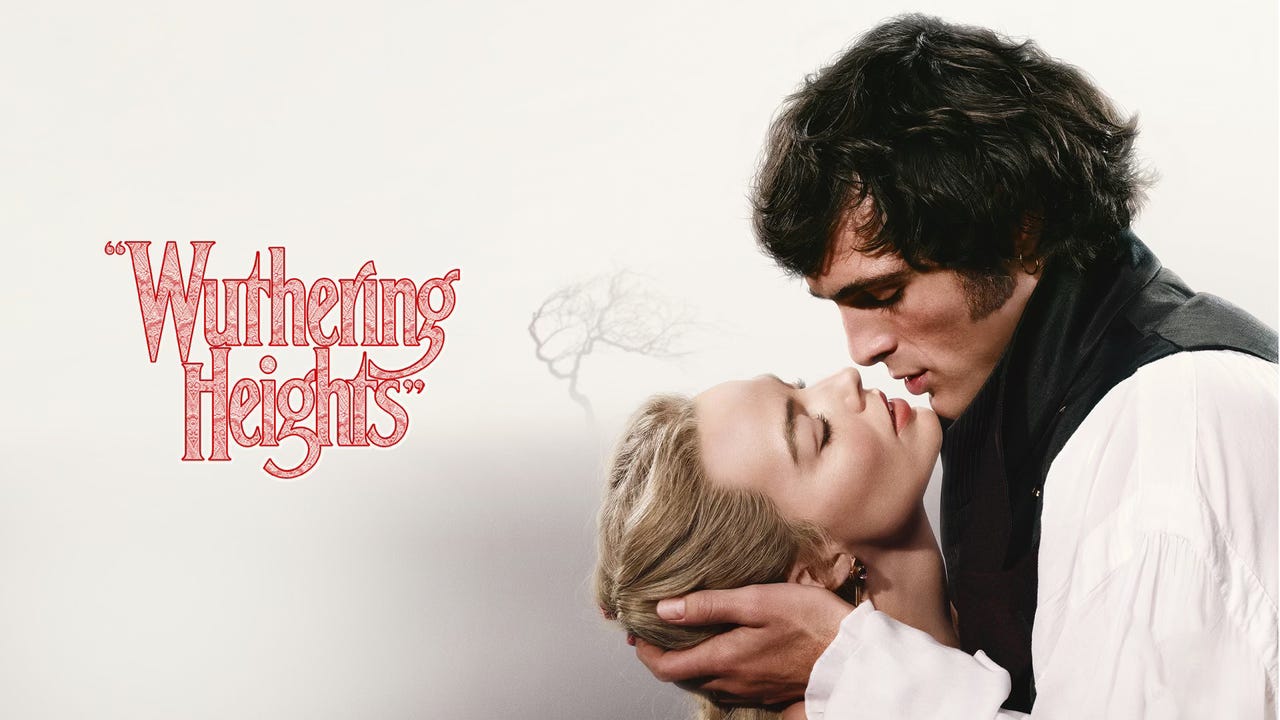
Emerald Fennell’s “Wuthering Heights” earns those quotation marks—serving as a fever-dream of an adaptation, taking extensive liberties with the source material while honing in on a very modern vibe that, I am quite pleased to say, really worked for me.
I was most surprised by how relatively tame this film is. Amy Poehler remarked on her “Good Hang” podcast about the “sexually violent third act turn” that occurs in all Emerald Fennell films. It’s easy to poke fun at Fennell’s penchant for shock (as we’ve seen in Promising Young Woman and, even more so, in Saltburn), and that’s not to say this doesn’t exist to some degree in “Wuthering Heights”—but it’s the restraint she displays in this film that makes the whole thing work even better than her previous films.
Excising almost half the book and a plethora of supporting characters, Fennell smartly focuses the story on Cathy and Heathcliff. Margot Robbie and Jacob Elordi are just great in this film as our two doomed lovers, matching each other’s freak like these two only can. These performances are key, because neither of these characters are particularly likable. In fact, there’s hardly anyone redeemable on display, except maybe our oh-so-innocent Edgar Linton (Shazad Latif), Cathy’s forlorn husband who never quite grasps what he signed up for.
Hong Chau’s Nelly and Alison Oliver’s Isabella are the true standouts. Elevated from a mere narrator role, Nelly is the most complex character on display. Her station in life as a maid to Cathy, stuck in a subordinate role while slowly accruing power through her own machinations, makes her someone you’ll find yourself rooting for one minute and hating the next.
It’s these themes of class and power that Fennell focuses on that I found particularly compelling. All our characters are trapped by the station they are born into, and as we peel back the layers, we find the ways some overcome their station while others are relegated to it. From Cathy’s ascension as the heir to the dilapidated Wuthering Heights to the lady of the opulent Thrushcross Grange; Heathcliff’s unexplained return as a well-groomed and rich man (this return is hilariously dramatic—the entire theater seemed to gasp as Elordi revealed a delicate hoop earring and a gold tooth); to Isabella’s deal with the devil, debasing herself to become a mere pet as she so frequently treated others, ultimately finding herself as she fulfills her destiny on her own terms and leaves for London (which makes me desperately want a sequel focusing on this journey).
Some may deride the whitewashed casting of Heathcliff, but if you are looking for a more faithful adaptation, I’d recommend Andrea Arnold’s 2011 film. This film works so well because it’s an adaptation rooted in memory and bias, rather than a slavish devotion to the text that inspired it. Fennell has a vision, and maybe it works for you or maybe it doesn’t, but it’s this singular vision that makes the film so compelling. Fennell, for all her flaws, is never an uninteresting filmmaker. The casting, the set design and production, the costumes—these all work because Fennell is brave enough to put everything she is on screen. She’s a risk-taker, and even when her films struggle, you can’t ever describe them as boring. I’d take this over a like-for-like adaptation any day (which, at that point, you can simply engage with the book itself).
In an age where TV and film are prioritized to fit on a vertical screen, or writers are implored to over-explain and to assume people are scrolling their phones while watching, a big-budget, loose adaptation such as this is a great respite in a world where AI slop is becoming more and more rampant. Take those quotation marks for what they are, and I implore you to engage with the art being presented to you—not some idea or expectation of what that art should be.
I could go on and on, but the one piece of the puzzle that elevates the film is the inspired collaboration with Charli XCX. Her soundtrack perfectly complements the visuals Fennell puts on display, while serving as her own interpretation of the original book. Every song elevates the scenes they accompany—and also happens to be a banger in its own right. Emerald Fennell is 3/3 in my book, and is possibly getting better and better. Whereas Promising Young Woman has a brilliant script (pushing the limits of what the costs of revenge really are), and Saltburn was a great ride but ultimately a superficial jaunt through the English aristocracy, it’s Fennell’s restraint with “Wuthering Heights” that finally allows her quiet moments to land as powerfully as her loud ones (the eggs are simply… iconic). If you are a fan of Baz Luhrmann’s Romeo + Juliet, you’ll find a spiritual successor with Emerald Fennell’s “Wuthering Heights.”